“Finding” Wayfinding
We found our way to Bali because of the Green School. We arrived, having never visited the island and with no place to live, two weeks before the kids started school in 2024. It just felt right. Still does.
But living here has been disorienting. I have known why our kids are in Bali but it has taken a while for me to figure out what I am doing here. The change of pace has given me the opportunity to practice new skills and the freedom to experiment as I explore unfamiliar materials. But the best gift has been the time to sense my way forward, to find my way. In doing so, I came upon the ART of wayfinding.
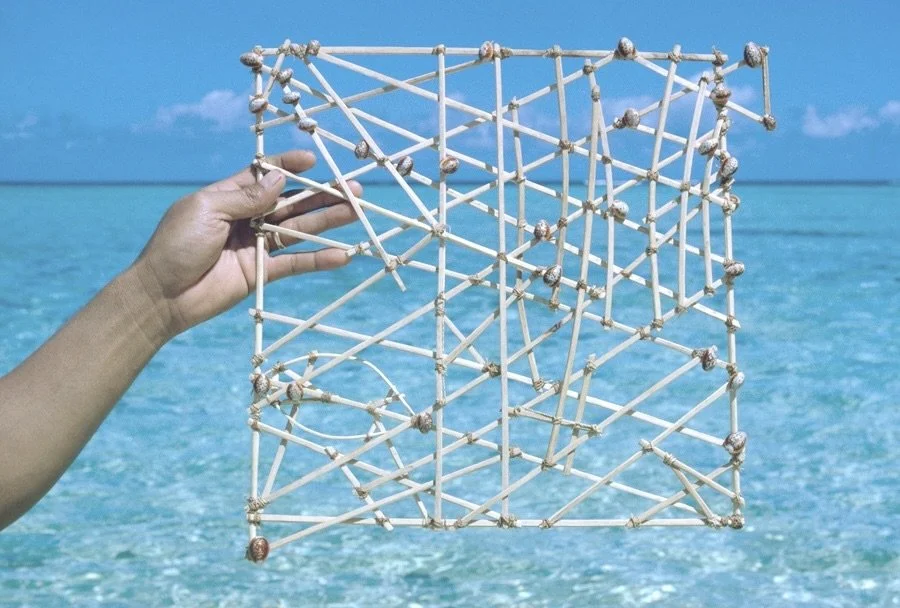
First I became aware of old Micronesian Stick Maps
which led me to read The Wayfinders by Wade Davis,
which introduced me to the world of Polynesian wayfinding.
Ancient Polynesian navigators, or wayfinders, were able to find their way across a remarkable expanse of seemingly endless ocean with no modern technology. And this at a time when “European ships, lacking the navigational instruments to determine longitude, were still hugging the coastline for fear of open ocean”.
Expert navigators… sitting alone in the darkness of the hull of a canoe, can sense and distinguish as many as five distinct swells moving through the vessel at any given time. Local wave action is chaotic and disruptive. But the distant swells are consistent, deep and resonant pulses that move across the ocean from one star house to another, 180 degrees away, and thus can be used as yet another means of orienting the vessel in time and space. Should the canoe shift course in the middle of the night, the navigator will know, simply from the change of pitch and roll of the waves. Even more remarkable is the navigator’s ability to pull islands out of the sea. The truly great navigators… can identify the presence of distant atolls of islands beyond the visible horizon simply by watching the reverberation of waves across the hull of the canoe, knowing full well that every island group in the Pacific has its own refractive pattern (….)
All of this is extraordinary, each one of these skills and intuitions a sign of a certain brilliance. But as we isolate, deconstruct, even celebrate these specific intellectual and observational gifts, we run the risk of missing the entire point, for the genius of Polynesian navigation lies not in the particular but in the whole, the manner in which all of these points of information come together in the mind of the wayfinder.
It is one thing, for example, to measure the speed of (a boat) with a simple calculation: the time a bit of foam or flotsam, or perhaps a mere bubble, takes to pass the known length separating the crossbeams of the canoe. But it is quite another to make such calculations continually, day and night, while also taking the measure of stars breaking the horizon, winds shifting both in speed and direction, swells moving through the canoe, clouds, and waves. What is even more astonishing is that the entire science of wayfinding is based on dead reckoning.
++++
Dead Reckoning: the process of calculating one’s position, especially at sea, by estimating the time and distance traveled from the last known point.
++++
The wayfinders were able to find their way by paying real attention. Learning about their methods has given me insight into the ways I pay attention, and to the tools that I use to navigate my own life.
These route notes are a way of sharing that.
All quotes are from The Wayfinders, by explorer and anthropologist, Wade Davis.
